Linear Design: Apple Composition
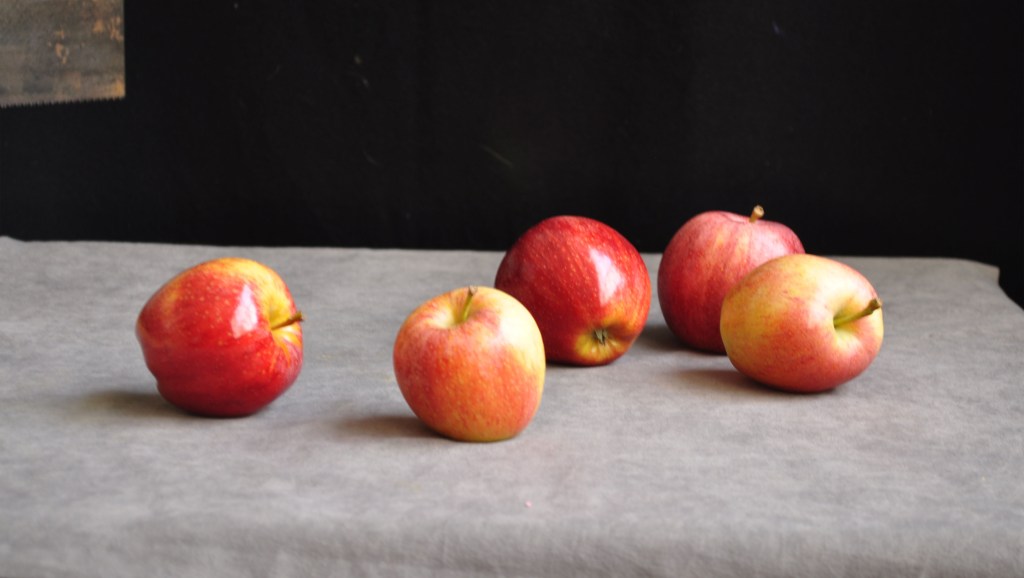
A strong composition is at the heart of good design. In this assignment we will be constructing a strong composition by looking at several elements. To place our apples in our drawing to form a compelling image, this will entail: where the apples are placed on the ground plane and how they work as single apples or as groups of apples; considering over-lapping the apples to create depth in the composition; consider shadow patterns and how much space these occupy and whether they can strengthen your composition; and finally the line quality, thick and thin lines, areas joined or separate. All these elements are necessary to create a solid image.
Apple Composition
Materials:
- 18 x 24 pad of white paper. This is from Drawing I.
- Charcoal, medium vine
- Kneaded eraser
- Comparison stick
- Rag, like an old t-shirt a piece the size of a handkerchief.
- Sandpaper, #220 or #150 or an emery board
- Drawing board or Amazon box
- a bag of cheap apples any color you like. You will need 5 or more apples.
Assignment:
- Set up your apples on your table like this- slowly empty the bag onto the table allowing the apples to randomly place themselves. This allows for a more spontaneous composition. Adjust some apples if necessary. Remove extra apples (you need at least 5 apples in the compo).
- Draw the apples on your 18 x 24 pad in a horizontal position. Use Strategies and comparisons to get accuracy with the size and exact placement of each apple.
- Lay in the shadow patterns, including the cast shadow. These will be value 4,5. Remember value 5 runs along the shadow edge. Value 4 is the reflected light within the shadow. Use parallel diagonal lines to lay in the values. Do not scribble it in.
- Next, lay in the middle value 3 on the light side. This occupies the transition between value 5 at the shadow edge and the light side.
- Next, lay in value 2,1,0 on light side. Value 0 is the highlight.
- Next, look at the outlines and the soft and hard edges. Use the kneaded eraser to add interest here, thinning the line/ softening the line or use charcoal to widen the line and harden the edges. Use variety. Each drawing should contain both aspects.
Upload a photo to the assignment section assigned to it. Instructions are at the bottom of every assignment page.
Due: M/W Monday, Feb.
T/TH Tuesday, Feb.
Secondly, Please watch the first Technique Video and answer the questions under the video, “Shadows in Animation”.
Due: M/W Monday, January.
T/TH Tuesday, January.
The Technique video/questions can be found on the content page on Brightspace under: Technique videos by other artists, educators and photographers. I will assign 1 (sometimes 2) video/questions per week. These will highlight a technique we will be exploring. Please keep up with these videos as there are 12 videos/semester.


 Drawing Class