Project 2: Tonal Relationships- The Middle Value
As we move away from a 2 value understanding as in Notan, we will begin to look at the middle value of an object and its general value relationship to the other objects within the still-life set-up. This will include observing the general value of the table and the background. So what do I mean by middle value? If we look at any object that has light upon it, you can observe:
- 1. The light upon the object which appears as a lighter value
- 2. The shadow side of the object. This is the side that is turned away from the light source and is a darker value. It includes the cast shadow- a shadow projected onto the table.
- 3. Those values that are between the two extremes- this is where the middle value lies- halfway between the light and the shadow.
In this lesson, we will focus on this area of the middle value. Think of it like this, every object begins as a middle value and it is upon this middle value that the light and the shadow are placed. It would be like observing the object on an overcast day. This is important because we need to understand how one object relates in value to the objects that surround it. There must be a scale of value between all the objects, including the table and the background in your still-life. This is the natural place to begin before we break down every object into 5 values and then add spatial relationships through value to include the table and the background.
Assignment
Materials:
18 x 24 pad, held horizontally
- Drawing board/ Amazon box
- Vine charcoal from the kit
- Sandpaper pad
- Rag
- Kneaded eraser
- Stumps [These are those grey, rolled paper instruments that are blenders for charcoal- choose 1 for this project that will be used for charcoal only. The other one or two will be used for conte only on Project 4]
- Comparison stick
Still-Life
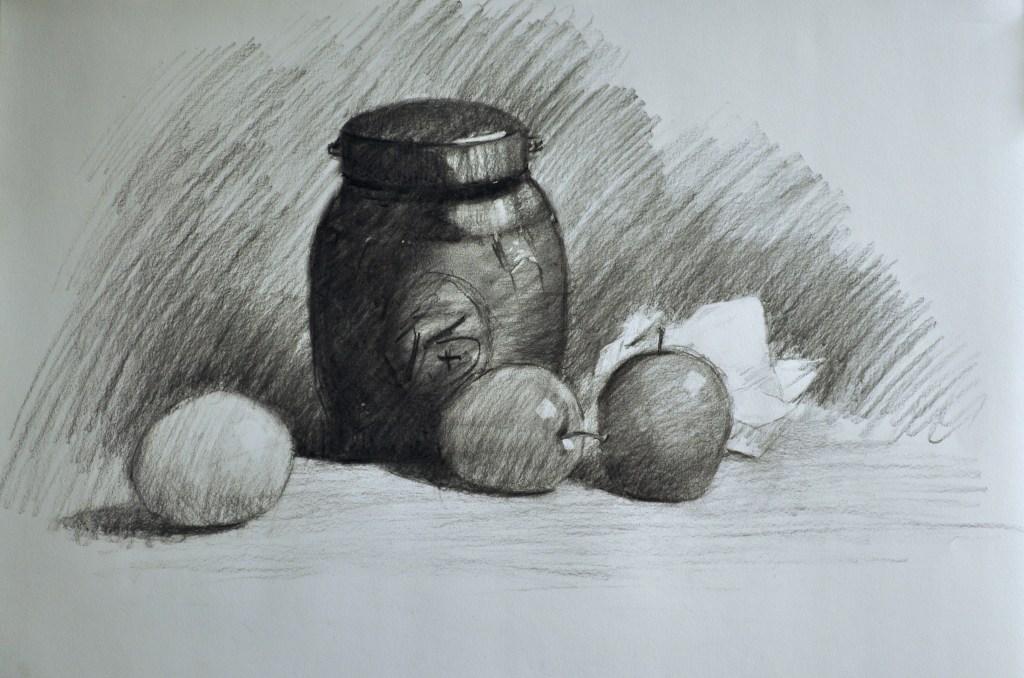
- A Black [Or very dark object. Like a navy blue, dark green bottle like olive oil etc] object like a bowl, coffee cup, bottle etc.
- White piece of copy paper
- 2 Red Apples
- 1 Orange or lemon or pear or green apple that is lighter than the two red apples
This is a total of 5 objects of 4 different values. Place on your table in a nice organization.
Assignment: To draw these 5 objects in the right value relationship to one another, laying in the middle value only; laying in the cast shadow on the table; Indicating the middle value of the table surface and the background.
Draw the 5 objects using the 4 strategies. Make your comparisons. Make sure all the objects are in the right relationship to one another. Make any corrections and redraw. Check proportional relationships. Next, examine the still life. Which object is the lightest? This should be the crumpled paper. Which object is the darkest? This should be the bottle, cup, bowl etc. Lay these 2 values in. This is the complete value range of your composition. Next, look at the apples and other organic object. Which one is darker? The apples? Lay this value in next. The remaining organic object, is this lighter than the apples but darker than the crumpled paper? Lay in this value. Next, check the table top. Is this darker than the paper, but lighter than the apples? Lay in this value. Lastly, look at the background. Is this darker by the crumpled paper, but lighter by the bottle? Vary the background to bring out the middle values of each object. Lighten or darken where necessary.
Evaluate the whole composition. Adjust any value that does not conform to the scale of values that you have create in the composition.
Upload photo of completed Project 2 to the Assignment section.
T/TH, Due:
M/W, Due:



 Drawing Class