Division of Thirds (or Rule of Thirds)
Before you watch my lesson, please make sure you watched the assigned video for today: https://youtu.be/7GcpP-n-94I
The last unit of study in Drawing I is composition. In class, I have only touched upon composition in a large way as we worked our way through the exercises in this semester. Now, I want to focus on composition by looking at two main systems that have been employed by artists. This first type, “Division of Thirds” is the primary compositional system used by contemporary artists, designers and photographers. We will build a view finder in order to examine a still-life arrangement in a new way.
Assignment Part 1
Materials
- Cardboard from a cereal or pasta box
- Scissors
- Dental Floss, string, yarn or any string like material. Could use very thin strips of paper or loose rubber bands.
- Tape
- Ruler to measure
Assemble
- Take your cardboard box and take apart at the seams and flatten to form 1 piece of cardboard.
- In the middle, cut an opening that measures 6″ x 9″.
- Mark 1/3 divisions on each side: 6″- Mark at 2″ and 4″. 9″- Mark at 3″, 6″.
- Place string/floss at these divisions and tape. They should be taut so they form a straight line.
Upload a photo of your completed view finder, T/TH, Due:
M/W, Due:
This view finder will be used for the next lesson also.
Assignment Part 2
Materials
- 11 x 14 pad, held Vertically
- Pencils- HB and 2B, 4B
- Gum eraser
- Ballpoint pen (You may put your grid in pen if you wish)
- Still-life objects: Assemble more objects than you think you need in any kind of arrangement on your work table.
Task
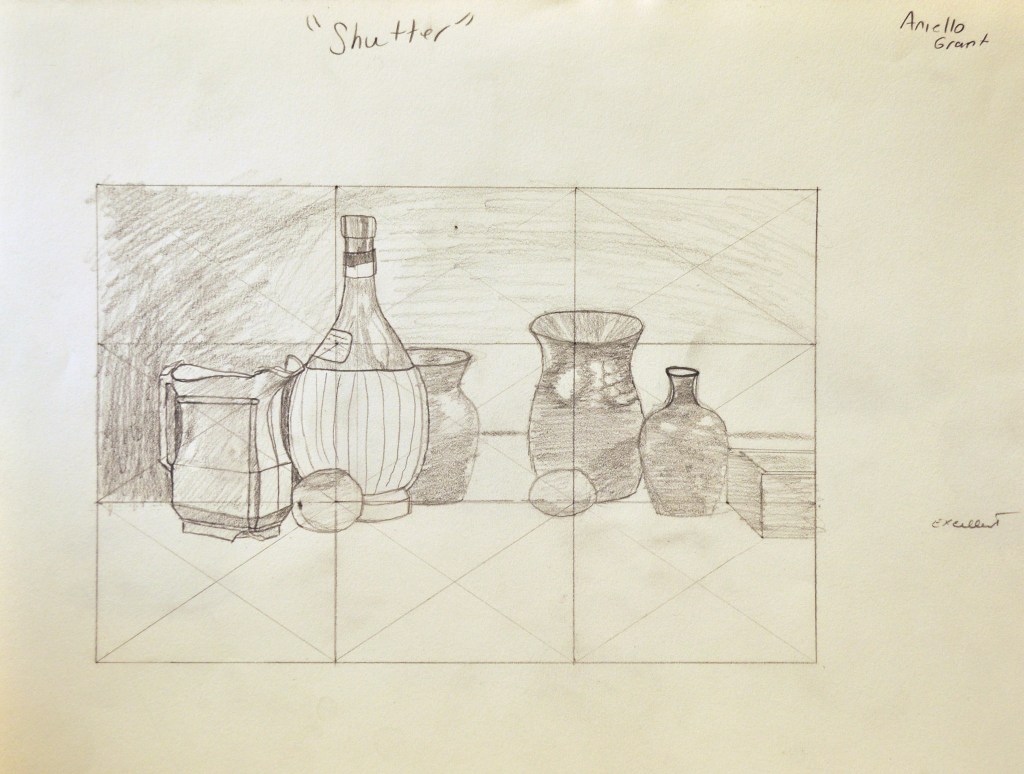
- On your sheet of 11 x 14 pad, create two rectangles that are exactly the same as your view finder: 6″ x 9″.
- Mark the exact same divisions as your view finder, so that both the finder and your rectangles are exact copies of each other.
- These two rectangles are one on top of the other. These are two different compositions.
- Align your finder with your still life, choosing where the division lines will fall along your objects. Can you align the edge of a bottle along one of the vertical divisions? Can you place another object within a rectangular division or resting on a horizontal division.?
- Use the entire space of the finder and your drawing rectangles.
- Remember: Keep your arm straight, use one eye to see through the viewer, and draw your objects. Once the objects are placed on your drawing, put down the finder and draw accurately what you see. Make corrections. Draw simple shadow and cast shadow shapes. Add simple tonal values to these shadows/cast shadows.
Upload a photo of this completed sheet to the assignment section.
T/TH, Due:
M/W, Due:
Due: “Sargent’s Male Figure”



 Drawing Class